This article was originally published on EcoTeq which is now proudly under the banner of Conquest. We’ve recently rebranded, bringing the same high-quality products, same experienced team, and same nationwide service guarantee together under one name to deliver even more value.
Noise pollution creating headaches
Noise pollution is a persistent challenge for local councils and contractors, particularly in densely populated residential areas. No one wants to be woken by the relentless rumble of a street sweeper at 3 AM or kept awake by the monotonous drone of a mower at 6 AM.
For many councils, noise complaints are now the number one complaint they receive. As a result, many councils have developed their own reporting and resolution processes for managing these burdensome noise complaints.
In addition to disrupting the community and generating complaints, noise pollution from sound and vibration also presents serious health and safety risks for workers operating noisy equipment over long hours. And councils and contractors must adhere to strict noise restrictions, limiting when they can and can’t operate.
All of these elements present challenges for councils to tackle! And electric, emission-free equipment is emerging as the answer.
How sound is measured
Sound levels are measured in decibels (dB) using a sound level metre. Because the dB scale is logarithmic, a 10 dB reduction equates to roughly half the perceived loudness.
The decibel scale starts at 0 dB, where human hearing begins. The scale goes up to 194 dB, which is the point where the eardrum can rupture, although 130 dB is the pain threshold for noise.
There are also dBA sound levels. The difference between dB and dBA sound levels lies in how they account for the way the human ear perceives different frequencies of sound. dBA levels are ‘A’ weighted, meaning they are adjusted using weighting curves to approximate the sensitivity of the human ear.
With a sound that has a 100 dB level at 100 Hz, when the “A” weighting is applied to this sound, it considers how the human ear is less sensitive to low-frequency sounds. As a result, the perceived loudness of this 100 dB sound at 1,000 Hz will be equivalent to only 80 dB.
dBA levels provide a more accurate representation of how humans perceive and experience sound.
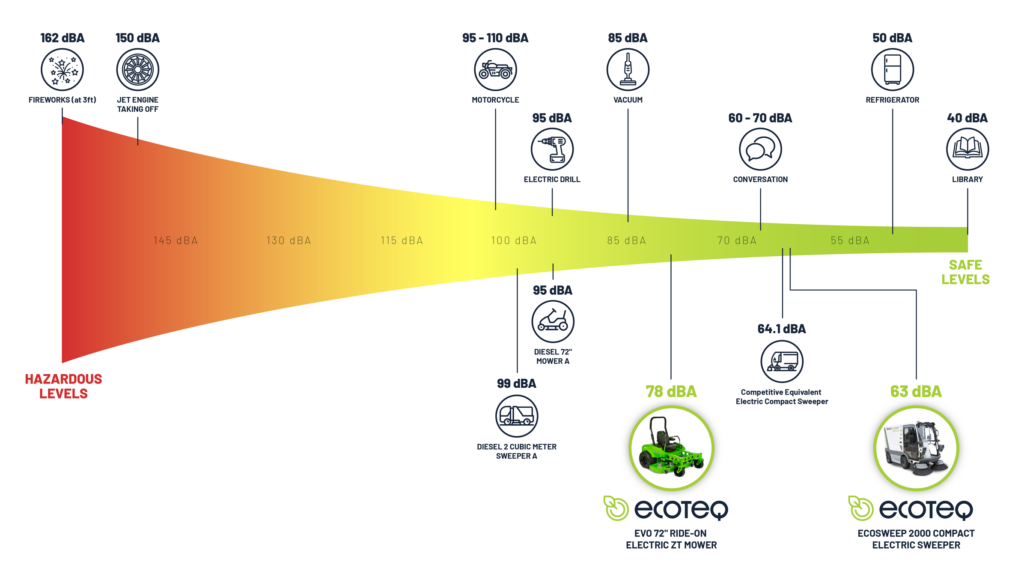
A commercial diesel-powered mower is around 90 to 95 dBA. A vacuum cleaner in the home is around 75 to 80 dBA. For further comparison, a chainsaw is 120 to 125 dBA, and a normal conversation is 60 to 70 dBA.
A small change in dB can represent a substantial difference in how loud the sound is. This is why we prefer to think about dB reduction as a solid number rather than as a percentage because a 30% reduction may not translate to what the ear will hear due to the logarithmic nature of the decibel scale.
To better visualise this transformation, refer to this scale that illustrates where Conquest (formerly EcoTeq) equipment stands on the sound scale compared to diesel machines. Note that the difference between ground-level and ear-level sound is striking.
To better understand the operational quietness of Conquest equipment, refer to the below table that details test results for the Rival 60″ Rear Discharge Mower at varying distances and blade speed settings.
| Test Number | Machine | Distance | Mower Settings | Max Volume |
| 1 | MG Rival 60” Rear Discharge | 1m | Blades Low Speed | 82.4dB |
| 2 | MG Rival 60” Rear Discharge | 1m | Blades High Speed | 81.8dB |
| 3 | MG Rival 60” Rear Discharge | 3m | Blades Low Speed | 75.3dB |
| 4 | MG Rival 60” Rear Discharge | 3m | Blades High Speed | 75.6dB |
| 5 | MG Rival 60” Rear Discharge | 5m | Blades Low Speed | 70.9dB |
| 6 | MG Rival 60” Rear Discharge | 5m | Blades High Speed | 71.4dB |
| 7 | MG Rival 60” Rear Discharge | 7m | Blades Low Speed | 66.4dB |
| 8 | MG Rival 60” Rear Discharge | 7m | Blades High Speed | 67.5dB |
| 9 | MG Rival 60” Rear Discharge | 12m | Blades High Speed | 55.3dB |
| 10 | MG Rival 60” Rear Discharge | 12m | Blades High Speed | 56.7dB |
Quiet maintenance equipment is the key
Electric outdoor landscaping and maintenance equipment is transforming the soundscape of outdoor maintenance, with electric outdoor mowers, sweepers and scrubbers reducing noise pollution – and noise complaints.
Conquest’s electric equipment operates at less than 83 dBA across its entire range, and often even lower. This means industrial maintenance can take place without the disruptive or damaging roar of traditional internal combustion engine (ICE) equipment. The implications for councils and contractors are profound.
1. Community-friendly maintenance
Electric maintenance equipment emits minimal operational noise, making it significantly less disruptive to surrounding communities. This allows councils and contractors to perform essential tasks such as street sweeping and lawn maintenance without triggering complaints or jeopardising public safety by being able to operate out of peak foot traffic periods.
2. Extended work hours
Imagine spring, when daylight hours lengthen, and the grass grows fast and long. By using electric mowers, operators have the flexibility to start their work day earlier and finish later while still complying with noise regulations.
The reduced noise levels also enable busy pavement and sidewalk areas to be cleaned at night when foot traffic is sparse, enhancing efficiency and minimising the disturbance to the public. In built-up residential areas, this is critical for reducing noise complaints.
3. Operator Safety
Sounds measuring 85 dB or louder, especially when exposed to them for an extended period, can potentially damage hearing. For operators, Conquest’s electric equipment operates at sound levels considered safe without the need for hearing protection while still adhering to current Work Health and Safety (WHS) guidelines. However, we still recommend using hearing protection for extended or prolonged exposure to low-level noise as an extra precaution.
Prolonged exposure to high sound levels in the workplace can have severe health consequences. It can lead to hearing loss, increase stress levels, and decrease overall productivity. Managing sound effectively is not just about maintaining a peaceful working environment, but also about safeguarding the health and well-being of the workforce.
Aligning with safety regulatory bodies and guidelines
In Australia, organisations like Safe Work Australia and its state- or territory-level equivalents play a pivotal role in setting safety standards for workplaces.
Using electronic outdoor landscaping and maintenance equipment gives councils and contractors greater flexibility to operate while still adhering to these stringent sound management standards.
Real-world implications of using electric maintenance machines
The impact of noise is far-reaching, with noise complaints being a leading cause of community dissatisfaction. But one Melbourne council discovered how electric sweepers can substantially reduce noise complaints and extend their operating hours.
A case study in noise complaint reduction
A council in the Melbourne metro area was in a position where they couldn’t conduct essential maintenance tasks like sweeping during the day because there were too many people around to do this work safely. And at night, they received far too many noise complaints from residents.
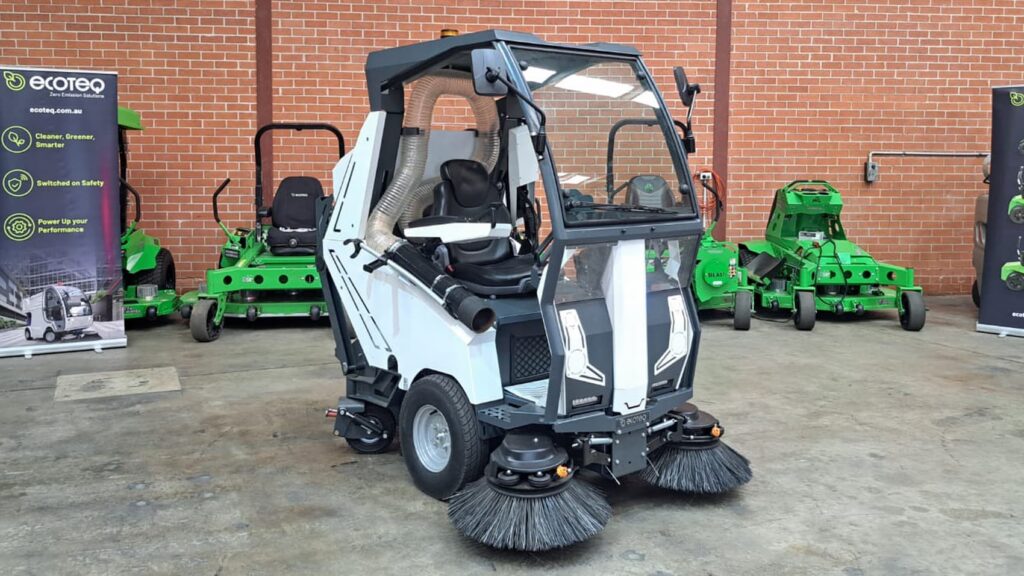
They turned to us for help. We arranged a middle-of-the-night demonstration using Conquest electric sweepers, which proved to be super quiet.
Because our electric floor sweepers ticked all the boxes, the council can now perform essential maintenance overnight safely and without bothering residents with the noise associated with street cleaning.
Expanding horizons
The significance of reduced noise extends beyond residential areas. Health care facilities, aged care facilities, education settings, and other environments where maintaining a quiet environment is imperative can all benefit from electric equipment.
Quiet, electric cleaning equipment won’t disturb patients or students, which is particularly important during exam periods or in patient care wings where rest is key to recovery.
Conquest’s commitment to lower noise levels isn’t just about meeting regulations. It’s about preserving the health and safety of operators and the peace of communities. By providing a quieter alternative, Conquest enables organisations to maintain their green and other outdoor spaces effectively without disrupting people.