With fuel prices continuing to rise and a new national exposure limit for diesel exhaust being introduced on 1 December 2026, now is the time to compare your options and consider whether petrol or diesel equipment is still the right choice for your business.
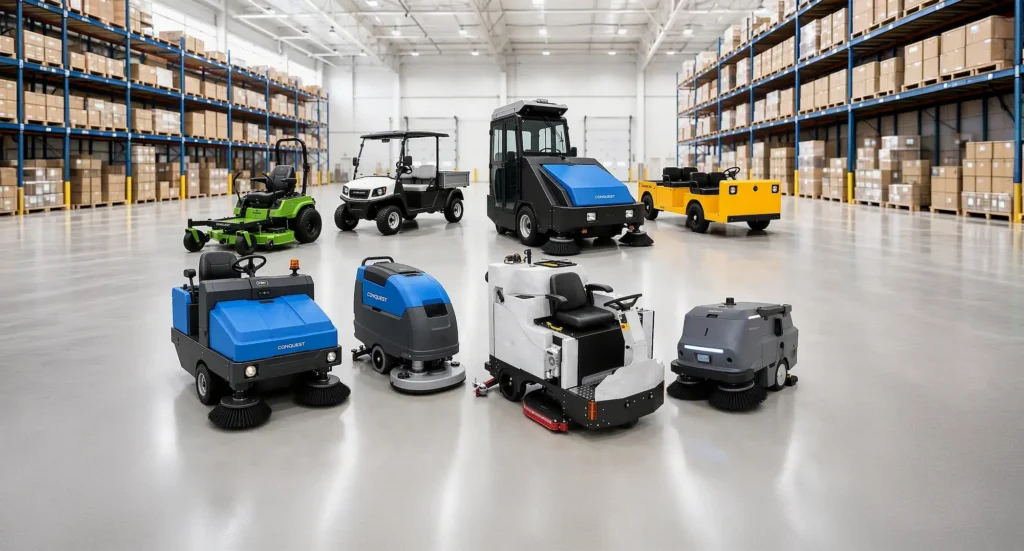
For operators and contractors running mowers, sweepers, scrubbers, street cleaning equipment, UTVs and industrial vehicles, the engine and power source can make a significant impact on daily operations and budgets.
This guide compares diesel and petrol equipment with electric equipment across the areas that matter most: power, cost, safety, and maintenance.
What is Diesel and Petrol Powered Equipment
Diesel and petrol equipment are powered by diesel or petrol engines. These engines require a constant supply of diesel or petrol to operate, plus the oil, filters, belts and servicing that come with a combustion engine.
They have been the default for commercial mowers, sweepers, scrubbers and utility vehicles for decades, largely because fuel is easy to carry and refuelling takes minutes. However, the trade-offs can be costly, from the harmful exhaust emissions, excessive noise, vibrations, ongoing maintenance, and a running cost that fluctuates with the fuel price.
What is Electric Equipment
Electric equipment replaces the combustion engine with a powerful electric motor and battery. The lithium-ion battery is charged from a standard power supply or charging station, typically overnight,providing long operating hours. The electric motor delivers power straight to the wheels, blades or brushes.
Electric equipment has no on-site exhaust, no fuel to store, and far fewer moving parts to maintain or replace. They’re also quiet and have low-vibrations, delivering a comfortable ride and better conditions for businesses and the surrounding community.
Comparing Equipment in the Areas that Matter
Power and Performance
One of the most common concerns regarding electric equipment is that it’s underpowered and won’t last through the shift. This may have been true once, but modern electric vehicles and equipment have come a long way, now delivering comparable power and performance to petrol and diesel equivalents and long operating hours.
While petrol and diesel equipment can deliver unlimited hours (with regular refueling), most electric cleaning equipment, vehicles and mowers can now deliver 7 to 8 hours of operation, covering a full shift before requiring recharging. They also deliver expansive floor or land coverage and power that’s equivalent or better than petrol and diesel alternatives.
For example, the electric SDM52 Ride-on Zero-turn Electric Mower produces horsepower comparable to a 36hp gas mower, maximum speeds of 18km/h, and up to 7 hours of continuous run time to cover up to 15 acres per shift.
Upfront and Operational Costs
Cost is also a major factor when selecting equipment. Upfront, electric equipment can be more expensive; however, on ongoing costs it wins out. Between fluctuating fuel costs and ongoing maintenance expenses, petrol and diesel equipment can cost businesses and contractors thousands of dollars each year.
Flexible short-term hire, long-term rental, and hire-to-buy options can make electric equipment more affordable. Moreover, business can also offset electricity costs by investing in solar.
To break down the average running costs, a diesel commercial ride-on mower consumes about 7.2 litres per hour, at an average cost of $2/litre, this adds up to $14 per hour of mowing, $112 over an 8 hour shift, and more than $500 in a standard working week. These costs add up quickly, especially when combined with maintenance costs.
Whereas, electric equipment averages approximately 1,000W per hour of active operation, meaning a full charge from grid power costs just a few dollars per day. Electricity costs are also more stable than fuel prices which fluctuate with global pressures.
Health, Safety and Compliance
Health and safety are paramount for operators and businesses. Emissions and high noise levels present risks for operators and anyone else close by.
Cancer Council has estimated that about one person every three days is diagnosed with lung cancer caused by diesel engine exhaust emissions exposure at work. In response, Safe Work Australia has now set a workplace exposure limit for diesel particulate matter of 0.01 mg/m³, applying from 1 December 2026. Zero-emission electric equipment allows businesses to meet these safety standards and protect their workers.
Moreover, Safe Work Australia has also introduced limits to state that workers cannot be exposed to 85 decibels or higher over the course of an 8-hour day or 40-hour week. Traditional petrol or diesel cleaning equipment, such as pressure washers frequently operate at 85 to 95 dB(A), while electric cleaning equipment, such as floor scrubbers typically operate between 60 and 80 dB(A). This is a significant difference for workers and the surrounding community.
The lack of emissions and quiet operations offered by electric cleaning and maintenance equipment not only helps businesses meet new health and safety standards but also helps them deliver better operating conditions for workers and keeps the community happier. Quiet operation also allows workers to start earlier or work during later hours when the streets are empty without causing disruptions or attracting complaints.
Maintenance
Maintenance is also a major factor for businesses and contractors leading to higher operating costs, operational disruption and downtime. With electric equipment, much of the servicing and maintenance that is required for combustion engines is gone.
There are no oil changes, spark plugs, fuel filters, hydraulic fluid, hoses, pulleys, spindles or belts to wear out. This saves hundreds of dollars each year as well as delivers hours of extra uptime with minimal disruptions.
The HDSS200 electric road sweeper, for example, can save over 90% on fuel and over 70% on maintenance compared with a conventional diesel sweeper.
Overall Comparison: Diesel and Petrol vs Electric Equipment
| Factor | Diesel and petrol | Electric |
| Power | High power | High: Equivalent output on commercial models |
| Upfront cost | Lower | Higher |
| Energy cost | High | Low |
| Price stability | Exposed to fuel price swings and excise changes | Regulated and falling for small business, can be offset with solar |
| Emissions Exposure | High emissions | No on-site exhaust |
| Noise | High: Often reaches limits within hours | Low: Quieter, lets crews work extended hours |
| Maintenance | High: Oil, filters, spark plugs, belts, hydraulics, blades, brushes, tyres, filters, battery care | Low: Blades, brushes, tyres, filters, battery care |
| Runtime | Unlimited with refuelling | 7 to 8 hours |
How to Make the Switch to 100% Electric Cleaning Equipment
If your business is looking to meet new environmental and safety standards, electric equipment is the way to go. And making the switch is easier than you may think:
- Book a site assessment: Conquest’s team can assess your floor area, terrain, shifts and charging options and recommend the best cleaning machine, mower or industrial vehicle for your space and needs.
- Trial before you commit: Request a demonstration to see it on your own site, or hire an electric machine from as little as one day to see if it suits your needs before you buy.
- Plan charging: Identify where machines will charge overnight, whether your power supply suits it, and whether solar can offset the load.
- Train your operators: Conquest provides comprehensive operator training with purchase or hire to help you get the most from your equipment.
If you’re ready to reduce your carbon footprint, minimise operational costs, and experience superior uptime, reach out to Conquest today for a site assessment and tailored advice.